5 Tools for the Researcher Without a Budget

One of the things I enjoy about research is that each day is different. Many projects have a predictable progression from research question to data collection, analysis and reporting. Other requests are less structured and can fall anywhere on the research cycle. These unpredictable requests usually have high priorities, short timelines and messy data that needs to be organized.

Following are five free tools that I have found helpful completing unexpected and high-priority requests.

Rstudio: http://www.rstudio.org/
Level of difficulty
: 8 out of 10

R is both a program language and an environment for statistics and graphics. The command line approach can be intimidating (think back to the days of DOS, before windows)  but its capacity for advanced multivariate statistics and graphing makes it worth the time and effort to learn. RStudio makes R much easier to use and is free. There is also a large community of users willing to help out those who are starting out with tutorials (blogs, pdf, video) and discussion forums. If you have never tried R or tried it but felt intimidated, I highly recommend taking a look at RStudio.

Twitter: http://www.twitter.com
Level of difficulty:
3 out of 10

Twitter is a social network that invites users to share thoughts and comments.  However, those comments must be limited to 140 characters. I’ve included Twitter as a tool because of the social networking capacity.  Not only are people sharing thoughts about their food, the person standing beside them on the bus and how they feel about the color green, they are also sharing professional resources.  There are several networks on Twitter that are populated be people who are more than willing to make recommendations on literature and resources on every topic under the sun.  If you are doing a literature review, a quick post on twitter can result in some amazing resources that you may not otherwise have considered or had access to.

Although Twitter is very easy to use, I’ve listed the level of difficulty as a 3 because there are some elements of etiquette and recommended constraints that you should familiarize yourself with before you get started.

iEtherpad: http://ietherpad.com/
Level of difficulty
: 2 out of 10

Etherpad is a tremendous collaboration tool that allows multiple users to edit/create the same document at the same time. A document space is created and attached to a unique web address which can be shared with others. All changes that are made are color coded to each person that has been working on the document.  A chat window provides an opportunity to discuss changes to the text and multiple versions can be saved to track changes as your document evolves.  Although Etherpad was purchased and shut down by Google, the source code has been made available and (thankfully) a new site is up and running at ietherpad.com

Joliprint: http://joliprint.com/
Level of difficulty
: 1 out of 10

Joliprint is an online tool that will turn web pages into very printer friendly pdfs. The web page text and graphics are reformatted into a two-column newspaper style layout with a timestamp in the header and url in the footer. In addition to being able to save the pdf, joliprint also includes options to share the pdf as a tweet, facebook post, email or shortened url (prin.tt). Archiving articles has never been easier.

Pdfunlock: http://pdfunlock.com
Level of difficulty:
1 out of 10

PDFUnlock is an online tool that was brought to my attention by a colleague. There are many cases where it is necessary to compile data from pdfs and not being able to copy and paste the text in leads to wasted time with data entry and validation. PDFUnlock asks you to upload a locked pdf, converts it to a format that can be copied/pasted and then lets you download it again. One word of caution though, since you upload your file to PDFUnlock give serious consideration to issues of copyright and data sensitivity before you use this tool.

Posted in Productivity, Research Resources | Tagged , , , | Leave a comment

This Week in Education – a Research Resource Roundup

Today’s blog post highlights some of the resources and articles that have crossed my desk.

Research Issues – Sampling

Sampling was a popular topic this week. Rather than simply cite chapter and verse from my collection of statistics textbooks, I thought I would explore the sampling resources that are available online. A Google search for the keywords research sample methodology returned over 27,300,000 results.

There are a variety of resources available on Canadian sites:

  • Statistics Canada has a section on their website called “Statistics: Power from Data!” and explores sample selection, probability and non-probability sampling as well as estimation.
  • The Ontario Institute for Studies in Education (OISE) has a pdf of chapter 10 in W.J. Popham’s “Educational Evaluation” (pp. 281-233) which reviews Sampling Strategies.
  • The University of Alberta’s Statistics Centre has a nice summary of Stratified Random Sampling.

On the International stage, the United Nations Educational, Scientific and Cultural Organisation (UNESCO) has made their modules available for Quantitative Research Methods in Educational Planning.  Sampling is explored in the third module which is entitled “Sample design for educational survey research” and was written by K.N. Ross.

Article: The Equity of Teacher Access and Socio-Economics (U.S.)

Do Low-Income Students have Equal Access to the Highest-Performing Teachers? Equity Institute of Education Sciences – National Center for Education Evaluation and Regional Assistance.  This American study finds that the highest-performing teachers are under-represented in schools with students from lower socio-economics. Teachers were deemed to be high-performing as part of a value-added analysis that measured the extent to which teachers contributed to students’ growth. The socio-economic level was drawn from the percentage of students that were eligible for free or reduced price lunch (FRL). Elementary schools were compared with middle schools.

Article: Legal Obligation of Boards to Identify Student’s Disabilities (U.S.)

Justices Seek U.S. Views on Special Education Case.   Education Week: School Law Blog.  This blog post by Mark Walsh summarizes a legal case from California where a parent has brought

” a negligence claim against a school district that allegedly failed to identify a high school student’s disabilities.”

Although the decline in the student’s work and academic achievement was noticed by the school staff. The question of liability was raised when recommendations from a mental health counselor were not followed to evaluate the possibility of a learning disability. The ruling (in favor of the student) resulting in a judgment for compensatory tutoring.

Research Competition: Data mining, analysis and visualization for Stephen Colbert?

Stephen Colbert To Award Research Competition Prize  Education Week – Inside School Research.  Stephen Colbert has put out a call to everyone interested in data analysis to explore the trends in a DonorsChoose database.  The DonorsChoose organization facilitates the provision of resources to classrooms. For more information on the competition and how to enter, check out the Inside School Research blog.

Posted in Research Resources | Tagged , , , , | Leave a comment

Research Lessons from Poetry

The following poem is one of my favorites and is also a good guide for writing research reports.  Unfortunately, I do not know who originally wrote this poem since it is attributed to “Anonymous”.  As you read it, try to figure out what the title might be.  Although it can be a challenging poem to read I encourage you to work through it to the end (it is more fun if you read it out loud):

In promulgating your esoteric cogitations, or articulating your superficial sentimentalities and amicable, philosophical or psychological observations, beware of platitudinous ponderosity. Let your conversational communications possess a clarified conciseness, a compact comprehensibleness, coalescent consistency, and a concatenated cogency. Eschew all conglomerations of flatulent garrulity, jejune babblement and asinine affectations. Let your extemporaneous descantings and unpremeditated expatiations have intelligibility and veracious vivacity, without rodomontade or thrasonical bombast. Sedulously avoid all polysyllabic profundity, pompous prolixity, psittaceous vacuity, ventriloquial verbosity, and vaniloquent vapidity. Shun double-entendres, prurient jocosity, and pestiferous profanity, obscurant or apparent.

In other words, talk plainly, briefly, naturally, sensibly, truthfully, purely.  Keep from “slang”; don’t put on airs; say what you mean; mean what you say.  And don’t use big words!

How uncomfortable did you feel reading the first stanza?  It uses language that is not very common.  Many of the terms are nuanced and technical.  Did it lead you to think back to all the times you needed to clarify conciseness?  Haven’t we all encountered a vacuity that is psittaceous?  Unfortunately, when presenting research it is very easy to use technical language that is just as uncomfortable.

When you have been involved in a project from the first proposal to the final report you can see nuances in the data and elegant patterns in the analysis.  Over the course of a research project terminology is learned, adapted and in some cases created to streamline conversations and interactions.  This may work well for researchers but for those who have not been involved in the project it becomes as challenging to understand as the first stanza of this poem.

Technical language is necessary and inevitable when working on a research project but it is dangerous when used in reporting.  Language that expresses the nuance and elegance of data is often a barrier that keeps research out of reach to the very people it is meant to influence or help.  Few people will ever take the time to learn the language to understand the meaning.

While the reader may get lost in poem’s first stanza, the second is easily understood.  With very few words (30 vs. 89 words) the meaning of the poem and the author’s lesson is plainly and simply revealed “say what you mean, mean what you say and don’t use big words”.    The sharing of research should more closely resemble the second stanza.  Although it is not as nuanced, the meaning is clear and the language is accessible.  And is that not the goal of all researchers?  To share what has been learned from research in the hope that it will be put into practice?

If you have not guessed already, the title of this poem is “Don’t Use Big Words” and you can hear it recited (from memory) here.

Posted in Blog | Leave a comment

Topics Trending In Education Research (Top-TIER): Ontario at the AERA

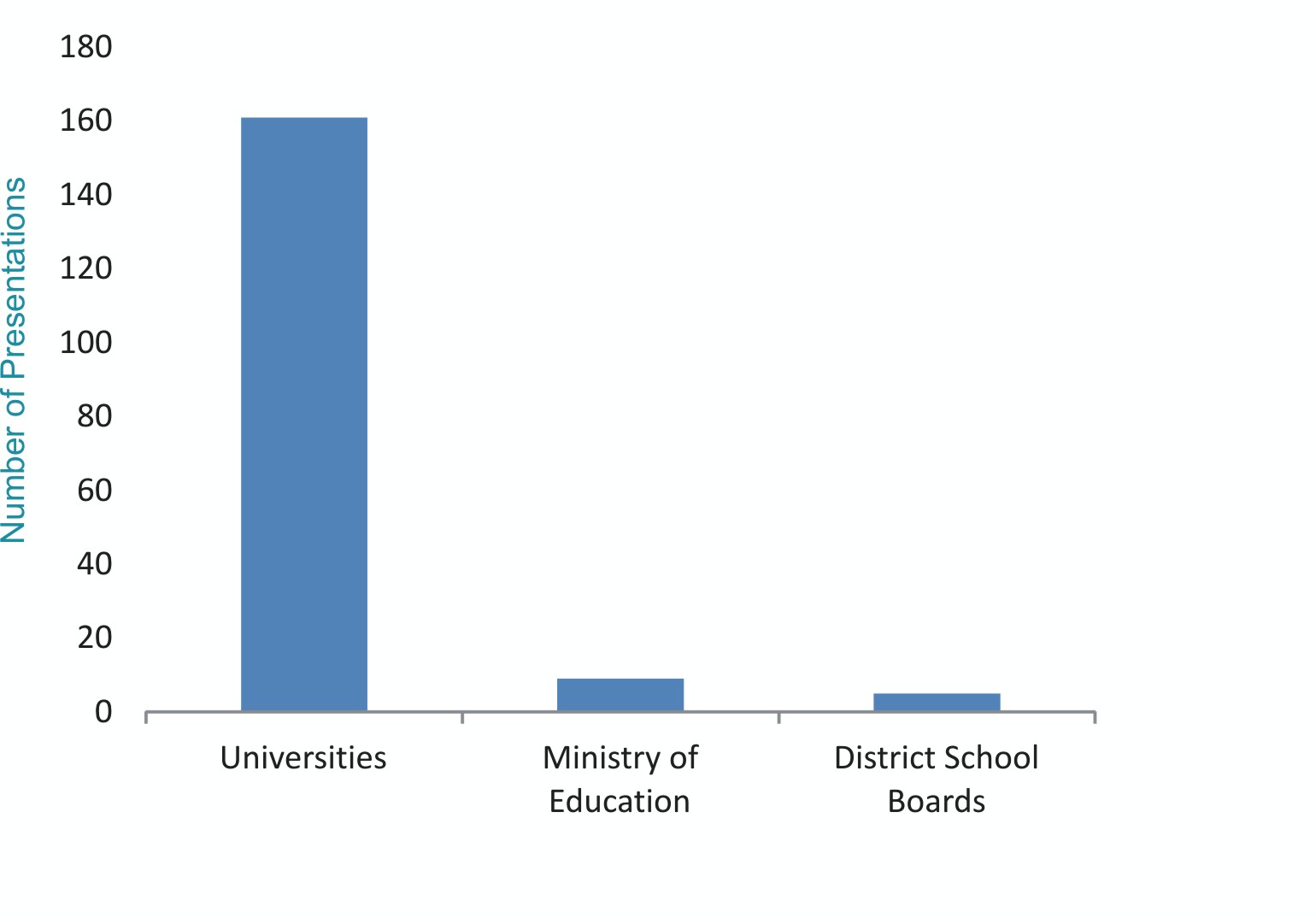
As mentioned earlier this week in the post “End of an AERA“, Ontario was well represented at this year’s American Educational Research Association (AERA) annual meeting.  Using this year’s program (“2011 Annual Meeting Program” ISSN 0163-9676) it was possible to identify Ontario researchers according to their listed  organizational affiliations.  Over the course of this 5 day event there were 177 presentations (papers, symposia or posters) delivered by researchers from Universities, the Ministry of Education and District School Boards from Ontario.

One notable feature of the AERA program is that each presentation has been categorized according to a theme or topic.  This is incredibly useful when you consider how many presentations are listed in the program.  AERA attendees used these themes to plan their days according to their areas of interests.

AERA categorized the Ontario presentations into 69 different themes.  The five most common themes were:

  • Teaching and Teacher Education (19)
  • Learning and Instruction (15)
  • Curriculum Studies (14)
  • Research, Evaluation and Assessment in Schools (9)
  • Administration Organization and Leadership (7)

Although the majority of the presentations featured University research (161) , research was also presented by the Ontario Ministry of Education (9) and Ontario District School Boards (5) .

A complete list of topics, titles and presenters is too long to include in a single post but is available here as a Google doc to anyone who is interested in exploring the Ontario research featured at AERA 2011.  This list not only provides insight into the current topical trends in Ontario Education Research but also highlights the variety of research that makes it Top TIER.

Posted in Top-TIER | Tagged , , , , , | 1 Comment

End of an AERA – AERA 2011 through the eyes of Twitter and R

The American Educational Research Association (AERA) holds an annual meeting that brings together researchers from across North America.  This year the AERA conference was held from Friday April 8 to Tuesday April 12 in New Orleans, Louisiana and had the theme “Inciting the Social Imagination: Education Research for the Public Good”.

While many researchers were not able to physically attend AERA we did have an opportunity to participate virtually.  Through the dedicated efforts of AERA presenters, attendees and members armed with mobile devices we have been given a glimpse into the discussions and have been given access to online resources through Twitter.

Although Twitter is largely known as a tool for social networking it provides a great opportunity for knowledge mobilization. As conference attendees listen to the presentations they sift through the materials and share the more salient points through short (140 character) posts.  As you might expect there are the occasional tweets about getting together with friends and commentaries on local restaurants but there are also links to websites and research studies.  For example, one of the presentations highlighted recent American research that explored relationships between grade 3 reading skills, poverty and high school graduation.

While the majority of the presentations highlighted American research, Ontario was well represented with presentations from the Ontario Ministry of Education, Universities such as Queen’s, OISE, UOIT and Western.

Prior to the AERA 2011 it was generally agreed by the #AERA Twitter community that the keyword (referred to as a “hashtag”) #AERA2011 would be used to identify comments related to the AERA events.  Not only did this coordinate the posting of comments but it also provided a reliable approach to analyzing comments about AERA.  Using R (a statistical language and platform) the package twitteR and assistance from Jeff Gentry (the author of twitteR), I have compiled and summarized tweets from the 2011 AERA meeting. I am more than happy to share the file with anyone who is interested, simply send me a quick email.

A note about the data: The data that has been compiled and summarized here is available as a csv file.  All tweets contained in the file were made between Friday April 8, 6:00 am to Tuesday April 12, 3:45.  The data was limited to the hashtag #AERA2011 which had the most activity.  For those Education Researchers in Ontario, a copy of the csv file will also be made available on the AERO-OERP wikispace

How much?
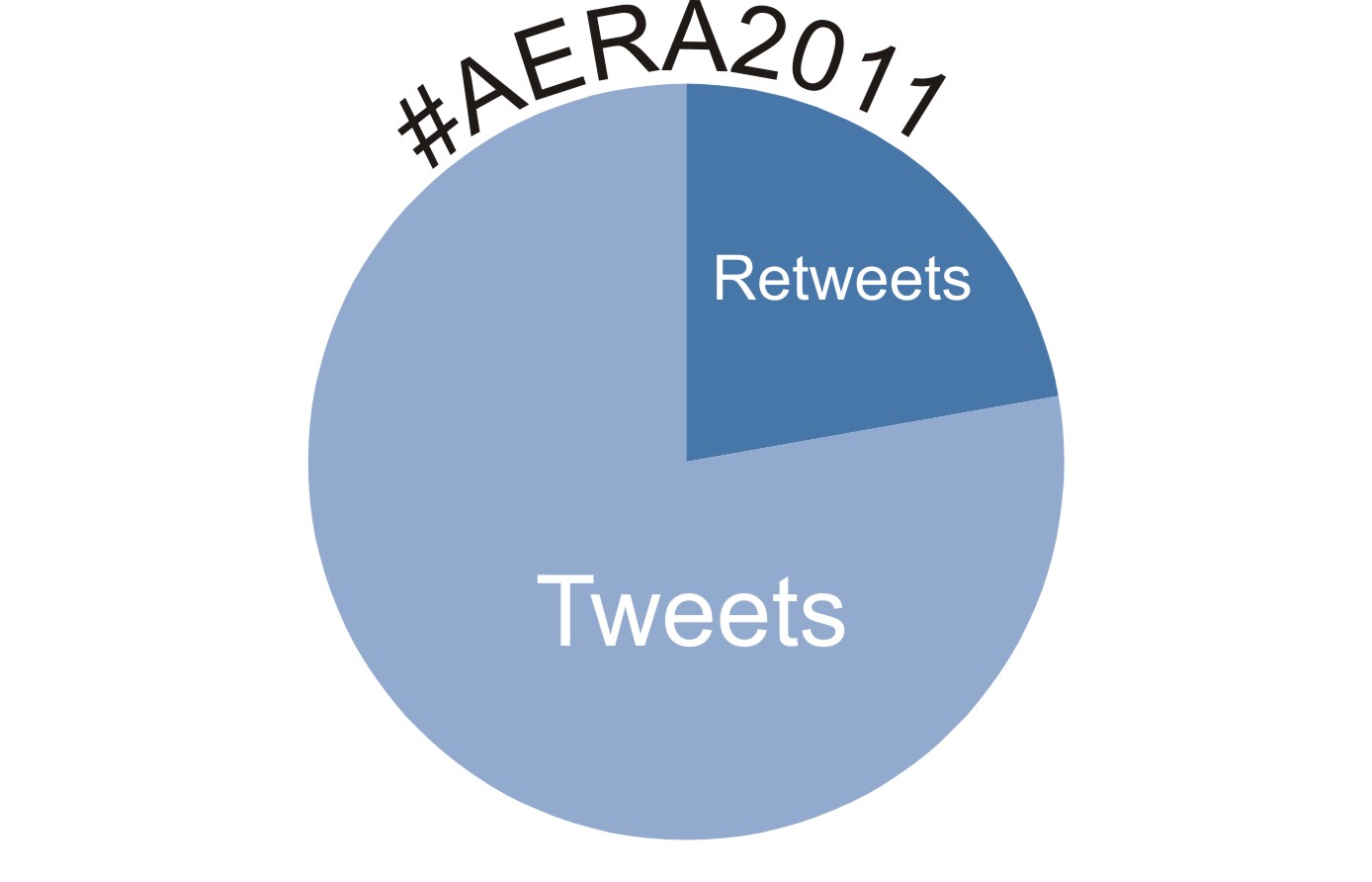
Of the 1292 tweets 77.8% (1006) were original tweets and 22.2% (287) were retweets (comments thought to be worth repeating, identified with the prefix RT).

Who?

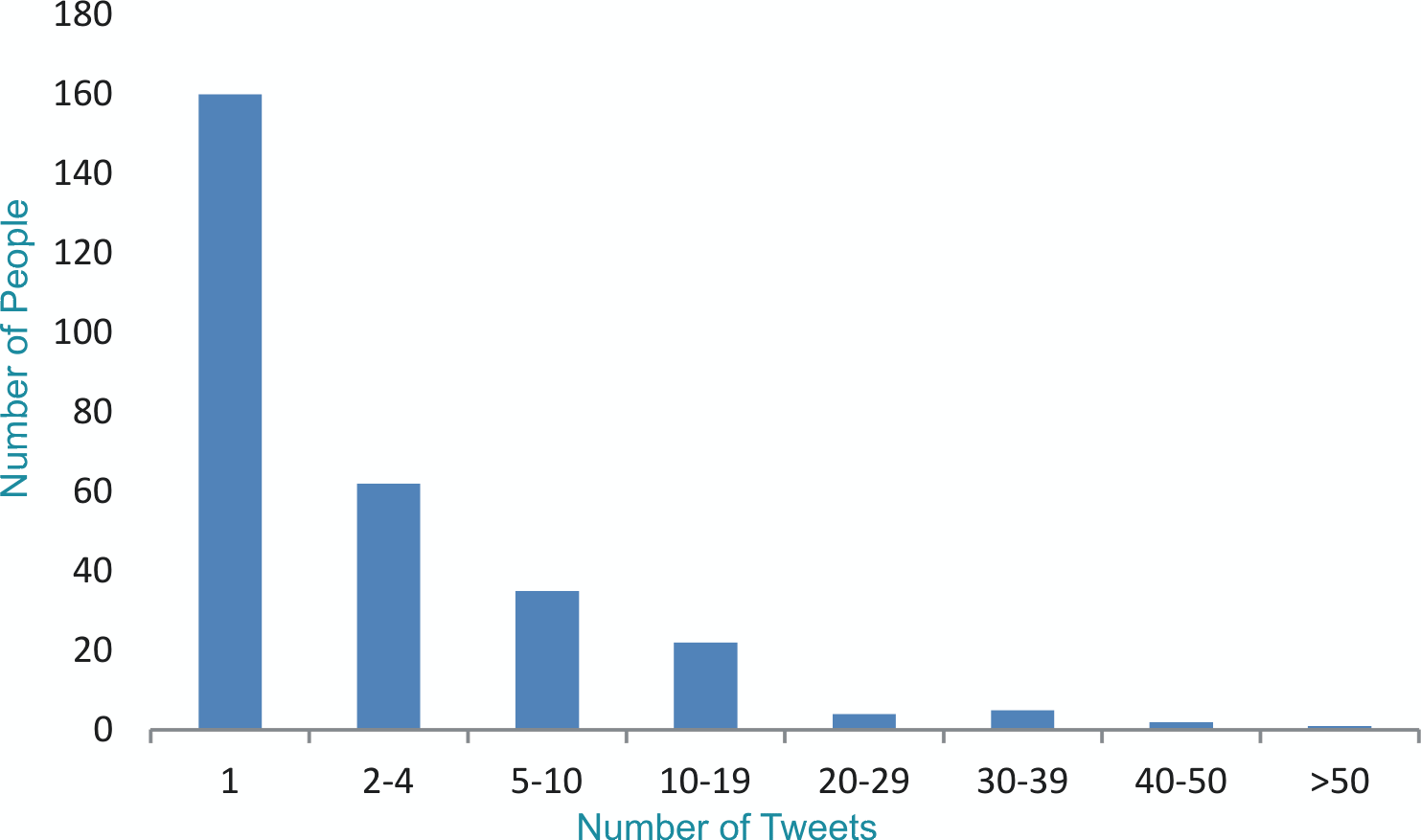
There were 291 people who posted something about AERA.  The three most prolific tweeters were ETSresearch (75), pm_rodriquez (46) and mcdanger (40).  The majority of people (160) sent only one tweet during the conference.

@BethFertig was retweeted the most (31 times) when she reminded us that

“Two thirds of variability in student achievement comes from factors OUTSIDE school, researchers remind us” (21 retweets)

and asked us

“Why does US have fewer students excelling in math-science? We’re self-absorbed says Gary Phillips of AIR” (10 times).

When?

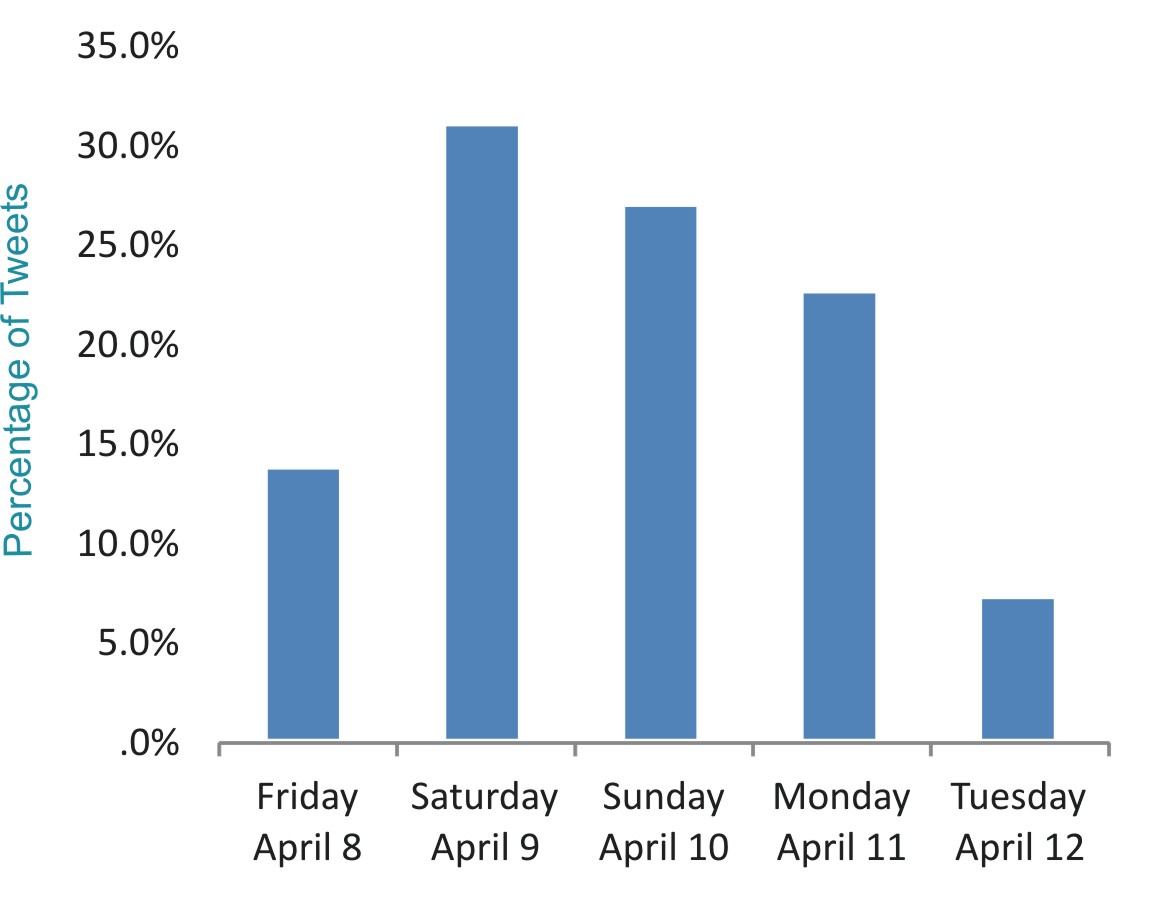
Perhaps not surprisingly, Saturday was the busiest with 30.7% (396) of the overall tweets for the conference.

Thank you to EVERYONE who attended AERA 2011 and made it possible for us to share in the learning.

Posted in Research Resources | Tagged , , , | 5 Comments