Unfortunately, the changes that were made to the long form census overshadowed another decision which is making detailed census data available to the public for free, rather than as products for purchase. To make it easier to locate these resources, all of the links referenced in this post are included as a list at the end.
The image of Canada, to the right, was constructed with these newly available boundary (dissemination block) and road network files which were posted on the Statistics Canada website in November 2012.
The first set of 2011 census data has also been posted but only for summaries of municipal, regional, provincial and territorial population and dwelling counts. The more detailed dissemination area data which is used by a variety of organizations for demographic analysis should be available later this month.
The census profiles of dissemination areas are large files that can be difficult to explore without the assistance of specialized software. Geographic Information Systems (GIS) have been developed specifically for this purpose which makes it possible to explore and share this data visually. For the researcher on a budget the open source GIS package Quantum GIS (QGIS) is available at no cost and features most if not all of the commonly used utilities and data formats as the proprietary GIS packages. If you are familiar with the ArcGIS or MapInfo software packages you should find QGIS straightforward to use. If you are unfamiliar with GIS there is a moderate learning curve but the process is so iterative that you will be able to pick it up quickly.
A video of the 2010-2011 EQAO Cohort Data Visualization with narration is now available. This expanded video includes narration on the origins of this visualization and orients you to the layout and features of the interactive chart.
In Ontario, students from Grades 3, 6, 9 and 10 participate in annual assessments of literacy and numeracy. This information is used in a variety of ways by the public and the education sector to inform planning and decision-making. In addition to managing the development, administration and analysis of these assessments, the Education Quality and Accountability Office (EQAO) also provides reports that summarize the achievement of students both provincially and locally.
One of the challenges of working with EQAO data is the sheer volume of data. Although there is a desire to define complex systems like education with a single number, it is only accomplished at the expense of provincial variation and diversity. Despite this significant challenge to the communication of results, EQAO has worked very hard to make this data accessible both to the public and to education stakeholders. EQAO’s detailed results and reporting approaches offer both high-level overviews and detailed breakdowns.
At the 40th Anniversary Fall Conference of the Association of Educational Researchers of Ontario, I had the opportunity to share a visualization of EQAO data that has been adapted from the field of genetics. This visualization, called Circos, was designed to explore structural variations in genomes. The advantage offered by this approach is that a large amount of data can be collapsed into a small space yet still allow for the visual exploration of this complex data. This visualization provides a new and interesting approach to data presentation which can also include interactivity with Mike Bostock’s Data-Driven Document (D3) javascript library. The following is an exploration of applying this approach to education data.
Left vs. Right
The circle in the following visualization represents the cohort of students who wrote EQAO’s Primary Reading Assessment in 2007-2008 and then wrote EQAO’s Junior Reading Assessment in 2010-2011. While the entire circle represents the cohort, the left side of the circle represents student achievement on the Primary Assessment and the right side of the circle represents student achievement on the Junior Assessment.
Segments
Each half of the circle has also been divided according to the achievement levels of the assessment:
Blue = Level 4 achievement
Green = Level 3 achievement
Orange = Level 2 achievement
Red = Level 1 achievement
Black = “Not Enough Information for Level 1”
Each of these coloured levels of achievement are comprised of two parts: a segment which forms the outside boundary of the circle (tick marks provide a reference to the number of students the segment represents) and a ribbon which connects the Primary Assessment (left side of the circle) to the Junior Assessment (right side of the circle).
Ribbons
The number of students at each achievement level is represented by the thickness of the ribbons and gives the visual impression of a pathway. Thick ribbons represent more students than thin ribbons. To facilitate comparisons, the ribbons have been sorted from thickest to thinnest within each of the achievement level segments.
Interactivity
The interaction that is offered by javascript provides the opportunity to explore each of the achievement pathways according to the achievement levels. In the interactive version of this chart, the mouse-pointer can be used to help focus on different ribbons. Using the visual metaphor of a pathway, hovering on ribbons or segments on the left side of the chart will let you explore where students “went” on the Junior Assessment. In contrast, hovering over a ribbon or segment on the right side of the chart will let you see where students “came from” on the Primary Assessment.
While the descriptions can be overwhelming, it is much easier to understand by interacting with the visualization. If you click on the image below, you will be taken to the interactive version of this chart which features the EQAO Reading Assessment cohort that wrote the Primary Reading Assessment in 2007-2008 and the Junior Reading Assessment in 2010-2011.
Note: If you are only able to see titles and no interactive image, try using a browser such as Firefox or Chrome. I have experienced difficulty viewing this page on Internet Explorer versions 6 and 7.
Finally, special thanks to EQAO for the opportunity to use and share this data.
Update: Several people have indicated that they are having difficulty accessing the visualization but would like to see it. I’ve created a short YouTube video to show the interactivity:
I’d like to express my thanks to the Association of Educational Research Ontario (AERO) for the opportunity to present at their 40th Anniversary Conference on December 1, 2011. For those who are visiting to explore the EQAO Cohort data visualization I shared during my presentation, it will be available shortly. In the meantime, please take a look at a couple of visualizations I shared earlier this year:
While you were out…. decisions were made, priorities were set and work continued to pile up. The start of a new school year is incredibly busy with very little time to explore topics and material that was distributed over the summer. It can be jarring moving from your summer respite:
to your winter residence:
As you settle in to the routines of a new school year take some time to read check out some of these articles that were posted over the summer.
Census
The Globe and Mail revealed that Statistics Canada “settles for incomplete long-form surveys in 2011 census”. The Globe and Mail reported that surveys with as few as 10 out of 84 questions completed have been accepted.
The Australian Government has created an interactive website that invites Australians to explore and play with the census data. There are a number of interesting approaches to presenting and interacting with data.
PISA
The Royal Society for the Encouragement of the Arts, Manufactures and Commerce (RSA) has created a series of animated features (RSA Animates) which combines hand drawn cartoons with the audio from a variety of presentations. Not only does this promote and expand the distribution of presentation materials, it makes the topics and presentation material even more engaging. One of the topics that RSA Animate has addressed is PISA. Unfortunately the artist in this clip has used a number of visual stereotypes which means the video is something I will watch (again) but probably not use with an audience.
Social Networking
At the end of the 2010-2011 school year there was a flurry of discussion about how social networking should or could be used. Michelle Davis explored “Safe Social Networking Tailored for K-12 Schools” which provides some examples of how educators in the U.S. have been approaching the issue.
Exanding on the Social Networking options, Google launched a new product at the beginning of summer called “Google Plus”. Since its launch there has been a great deal of speculating on how Google Plus could be leveraged in schools. Audrey Watters wrote this article entitled “Google Plus: Is this the Social Tool Schools have been waiting for?”.
Utility
One of the challenges using mobile devices is trying to review attached documents. It can be frustrating reading and navigating a PDF on a small screen. The utility PdfMasher solves this problem by importing pdfs and dissecting them into smaller, more manageable sections. At this point, PdfMasher only deals with text.
Data Visualization
In July, Charlie Parks wrote an article that explores a seldom used visualization called a “slope graph”. At the end of Charlie’s post he invited readers to submit examples of slope graphs and to continue the discussion on their use and application. Using information from the Ontario Health Sector, I posted an example of a slope graph and made a few suggestions on how it might be altered/expanded.
In August I came across an article that discussed how a false or mistaken claim evolved into a “fact” that was quoted both in public presentations, organizational materials and publications. The article by Ross MacKenzie and Becky Freeman serves as an object lesson for why it is important to challenge and question seemingly obvious facts and claims. Building on this article, I created a couple different visualizations to highlight the movement from fiction to fact. The original article is article emphasizes why it is important to challenge
On the Stranger Side of Research
For those who were concerned, scientists proved this summer that the Universe is probablyNOT a hologram.

 The image of Canada, to the right, was constructed with these newly available boundary (dissemination block) and road network files which were posted on the Statistics Canada website in November 2012.
 share this data visually. For the researcher on a budget the open source GIS package Quantum GIS (QGIS) is available at no cost and features most if not all of the commonly used utilities and data formats as the proprietary GIS packages. If you are familiar with the ArcGIS or MapInfo software packages you should find QGIS straightforward to use. If you are unfamiliar with GIS there is a moderate learning curve but the process is so iterative that you will be able to pick it up quickly.
 The circle in the following visualization represents the cohort of students who wrote EQAO’s Primary Reading Assessment in 2007-2008 and then wrote EQAO’s Junior Reading Assessment in 2010-2011. While the entire circle represents the cohort, the left side of the circle represents student achievement on the Primary Assessment and the right side of the circle represents student achievement on the Junior Assessment.
 The number of students at each achievement level is represented by the thickness of the ribbons and gives the visual impression of a pathway. Thick ribbons represent more students than thin ribbons. To facilitate comparisons, the ribbons have been sorted from thickest to thinnest within each of the achievement level segments.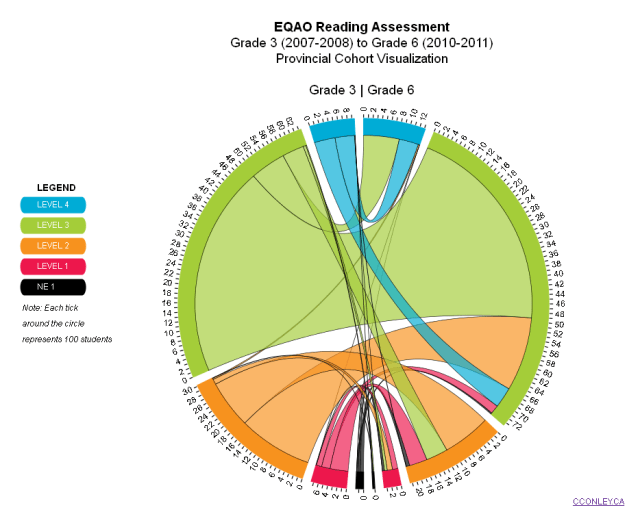


 CConley.ca